
· 9 min read · Spearos Pacífico
Most people who try spearfishing for the first time expect it to be about the shot. It isn't. The shot is the last few seconds of a much longer process — reading the water, controlling your breathing, moving quietly, understanding what you are looking at and deciding whether to take a fish at all.
That is why a first day is best spent learning the order of things. Punta Mita is an unusually forgiving place to do it: warm water, protected reef close to shore, and a short run from the marina, so more of the day is spent in the water instead of travelling to it.
It Begins With Breathing, Not Hunting
Spearfishing here is done on a single breath. No tanks, no bubbles, no noise — just you, a mask, fins and the time your body gives you. Learning to use that time calmly is the whole foundation of the sport.
Breathing well before a dive means breathing slowly and normally, relaxing your shoulders and jaw, and letting your heart rate settle. It does not mean packing in as much air as possible. Hyperventilating — fast, forced breaths before going under — is one of the most dangerous habits a beginner can pick up, because it delays the urge to breathe without giving you more oxygen.
The practical version is simple: relax at the surface longer than you think you need to, dive with intention, and come up early rather than late.
- Never hold your breath alone, in any depth of water.
- Surface with air still in reserve — the goal is a comfortable dive, not a maximum one.
- Rest at the surface for longer than the dive itself before going down again.
- Stop for the day when you feel cold, tired or rushed. Fatigue makes bad decisions cheap.
The Buddy System Is the Safety Equipment
One up, one down. That is the rule experienced spearos live by: one diver goes down while the other stays at the surface watching, ready to help. It is unglamorous and it is the single most effective safety measure in the sport.
A good buddy watches the whole dive — the descent, the time on the bottom and, most importantly, the last few metres of the ascent, where a blackout is most likely. They stay close enough to reach you and they know what they are looking for.
On a guided day this responsibility sits with your instructor, but it is worth understanding from the beginning, because it is the habit you take with you into every dive afterwards.
Learning the Reef Before You Hunt It
The reefs around Punta Mita hold a mix of species that change through the year: snapper, grouper, triggerfish, jacks and, in the right conditions, larger reef fish moving through. Knowing which is which is not a formality — it decides whether a fish is legal, whether it is worth taking, and whether it is a fish you can actually handle.
The habit worth building on day one is identify, then judge, then decide. Identify the species. Judge its size honestly, remembering that water magnifies. Then decide whether to take it, knowing you can always let it swim.
Selective hunting is not a marketing line. A reef that is hunted carefully keeps producing; one that is stripped does not. Taking only what you will eat that day is both the ethical answer and, in a place people return to year after year, the practical one.
What You Actually Wear and Carry
For a first day, equipment is provided, so the point of this section is understanding what each piece is doing rather than shopping for it.
- Mask: low volume, so it takes less air to equalise as you descend. Fit matters far more than price.
- Snorkel: simple and unvalved, so it drains and clears predictably.
- Fins: long-bladed freediving fins move you efficiently at slow speed, which is what quiet hunting requires.
- Wetsuit: warmth and protection from reef and sun, more than insulation alone.
- Weight belt: enough weight to be neutral, not heavy — worn on the hips with a quick release.
- Speargun or pole spear: beginners start short. Shorter guns are easier to aim and safer to handle in confined reef.
If you decide to buy your own gear later, our shop lists what the supplier catalogue specifies for each item — including fit notes and what a piece is designed for — and you can message us before ordering. Nothing about spearfishing equipment rewards guessing.
A Realistic First Day
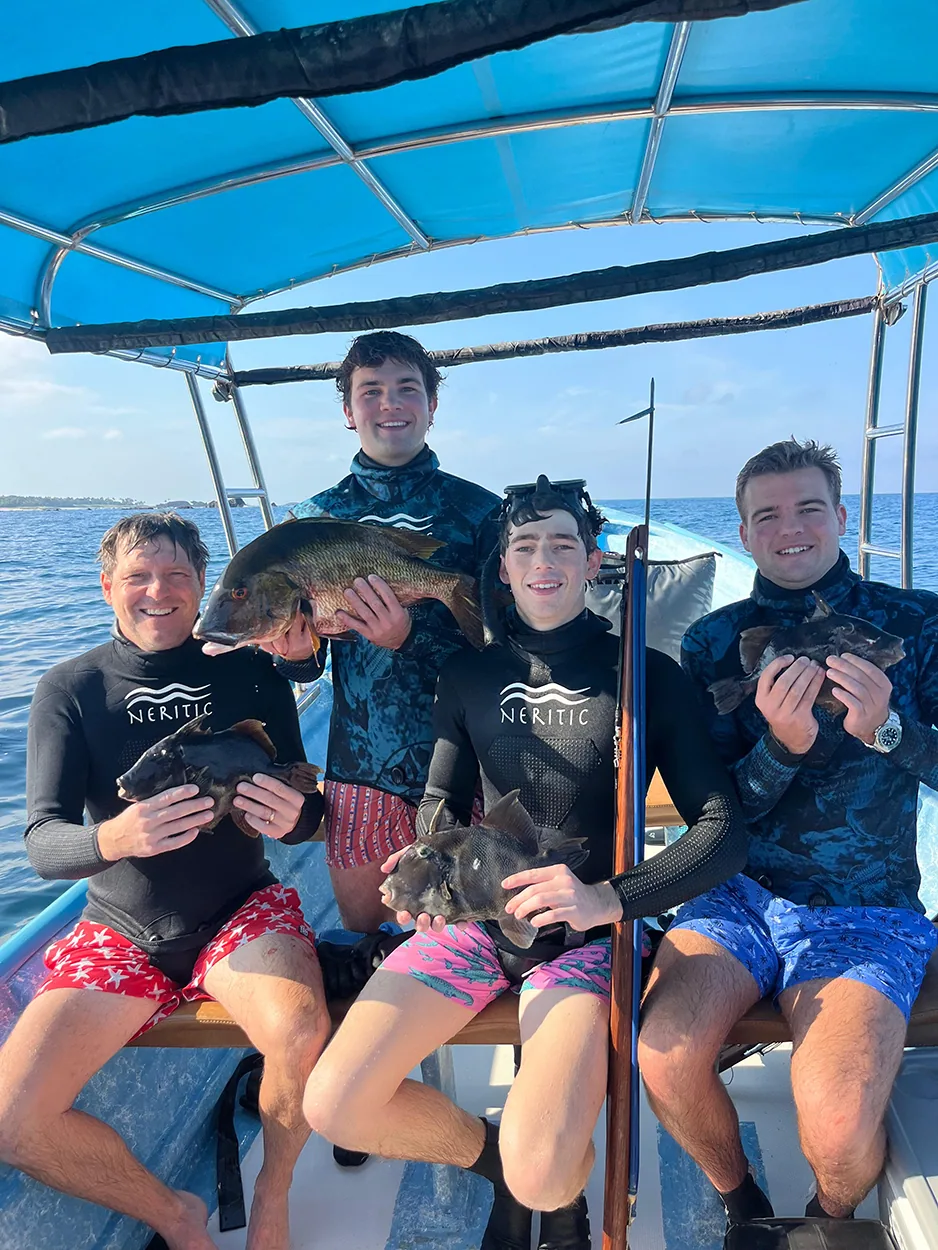
Our Spear Level 1 programme runs three and a half to four hours and covers basic breath-hold and breathing technique, safety in and out of the water, safe speargun handling, reef species identification, basic reef hunting technique, and cleaning and filleting the catch. If the day produces a fish, it usually ends with fresh ceviche on the boat.
That structure exists because it mirrors the real order of the sport: breathe, stay safe, understand what you're looking at, then hunt.
Expect to be surprised by how tiring calm movement is, how much you missed on your first few dives, and how quickly your comfort improves once you stop fighting the water.
The best beginner dive is not the deepest one. It's the one you came up from relaxed, having actually seen what was down there.
Habits Worth Keeping
Almost everything that separates a safe, effective spearo from a lucky one is a habit rather than a skill.
- Plan the dive with your buddy before you get in the water.
- Load the gun in the water, facing away from everyone.
- Keep your catch handled properly and cool from the moment it comes aboard — it's food.
- Log what worked: tide, current, visibility, depth, species. Local knowledge is built this way.
- Ask questions. Every guide here has answered them before.
Do I need spearfishing or freediving experience to start?
No. Spear Level 1 is designed for beginners and first-time hunters, and covers breathing, safety and basic reef technique from the beginning. You should be comfortable swimming in open water.
Do I need my own equipment?
No. Full spearfishing equipment is included on our guided trips. If you'd rather use your own mask or fins, bring them.
How deep will I dive?
As deep as you are comfortable. Reef spearfishing here is often productive in shallow water, and a good first day is about control rather than depth.
Is spearfishing dangerous?
It carries real risk, which is why it is taught with a buddy system, quick-release weights, a dive flag and clear speargun-handling rules. Breath-holding alone is never acceptable.
Will I catch a fish?
Maybe. Species, visibility and conditions change daily, and catch is never guaranteed. A first day is judged on what you learn.