
· 13 min read · Spearos Pacífico
Three days. One boat. Endless bluewater.
Journey beyond Punta Mita for an immersive offshore expedition combining sport fishing, bluewater spearfishing, remote pinnacles, deep drop-offs, open-ocean nights, and fresh Catch & Cook meals.
Before sunrise in La Cruz
At five in the morning, Marina La Cruz de Huanacaxtle is a quiet place with a lot going on. Navigation lights lie flat on black water. Dock carts roll past with coolers, ice, and dry bags. Spearguns come aboard first and get stowed with more care than anything else, followed by rods and reels, fins, food, water, and the unglamorous offshore gear nobody thinks about until it is needed.
Guests arrive with that particular mix of half-sleep and anticipation. Coffee gets handed around. Your guide runs through the forecast one more time, talks through the intended direction for the day, and explains what would make us change it.
By then most of the work has already happened. An offshore expedition is decided days in advance: weather windows, fuel planning, food and water, safety equipment, and a strategy loose enough to survive contact with the real ocean. Then the lines come off the cleats, the marina slides behind you, and land stops being part of the plan.
Why 2.5 days changes the experience
A single-day charter has one shot at getting it right. You run out, you fish the window you have, and you come home. When the water is good, that is plenty. When it is not, there is no second act.
A multi-day expedition changes the arithmetic. There is time to search for productive water instead of settling for the nearest option. More distant offshore structure comes into range. The route can be adjusted mid-trip based on what we have actually seen rather than what we hoped for. Morning, afternoon, and sunset windows all become available, and no single session carries the weight of the whole trip.
Then there is the part that is hard to explain until you have done it: waking up already offshore. No two-hour run to get back to where the fish were. You open your eyes and the ocean is right there, in a completely different light than the one you left it in.
Distance creates opportunity, but time creates flexibility.
None of which guarantees more fish. Travelling farther is not a formula. It simply widens the range of possibilities and gives us more chances to be in the right water when something happens.
Day One — the journey begins
Approx. 5:00 AM
Departure from Marina La Cruz
Gear stowed, forecast reviewed, and the run offshore begins in the dark.
Coastal water gives way slowly. The green-blue of the bay turns deeper and cleaner, the swell lengthens, and the coastline behind you becomes a suggestion rather than a landmark.
Approx. 30 miles
The first offshore pinnacles
Roughly thirty miles out, the first pinnacles come up on the sounder. Fishing begins with sport fishing or spearfishing, depending on conditions and what the water looks like when we arrive.
We drift over the structure, watch the surface, and search bluewater for pelagic fish.
Approx. 50–60 miles
Deeper drop-offs
When conditions permit, the day pushes on toward deeper drop-offs and productive areas in the 50 to 60 mile range.
Route, distance, and timing all depend on weather, safety, current, fuel planning, visibility, and recent fish activity. Nothing about it is fixed in advance.
Sunset
Final session, then dinner aboard
The day finishes with a sunset rod-and-reel session, then dinner aboard and rest before day two.
Between those waypoints, most of the work is watching. Birds, and specifically what they are doing rather than just where they are. Bait on the surface or on the screen. Current lines where two bodies of water meet and leave a seam of debris. Colour changes. Floating structure. Any surface disturbance that does not belong. Temperature shifts. After enough years, these signs stop being a checklist and become something closer to instinct.
The first offshore pinnacle
You will not see it. That is the strange part of fishing offshore structure — the pinnacle that changes everything about a piece of ocean is invisible from the surface, marked only by numbers on a screen and, if you are lucky, by what the water is doing above it.
What structure does is disrupt. It bends current, gathers and concentrates bait, drives upwelling that brings colder nutrient-rich water up from below, and gives predators a reason to hold in an otherwise featureless place. That is why fishing strategy changes the moment you arrive over one.
The specific spots stay with us. What we will share is the decision that follows: get in the water, or fish from the boat. That call belongs to the guide and rests on current, visibility, swell, and the ability and comfort of the guests aboard.
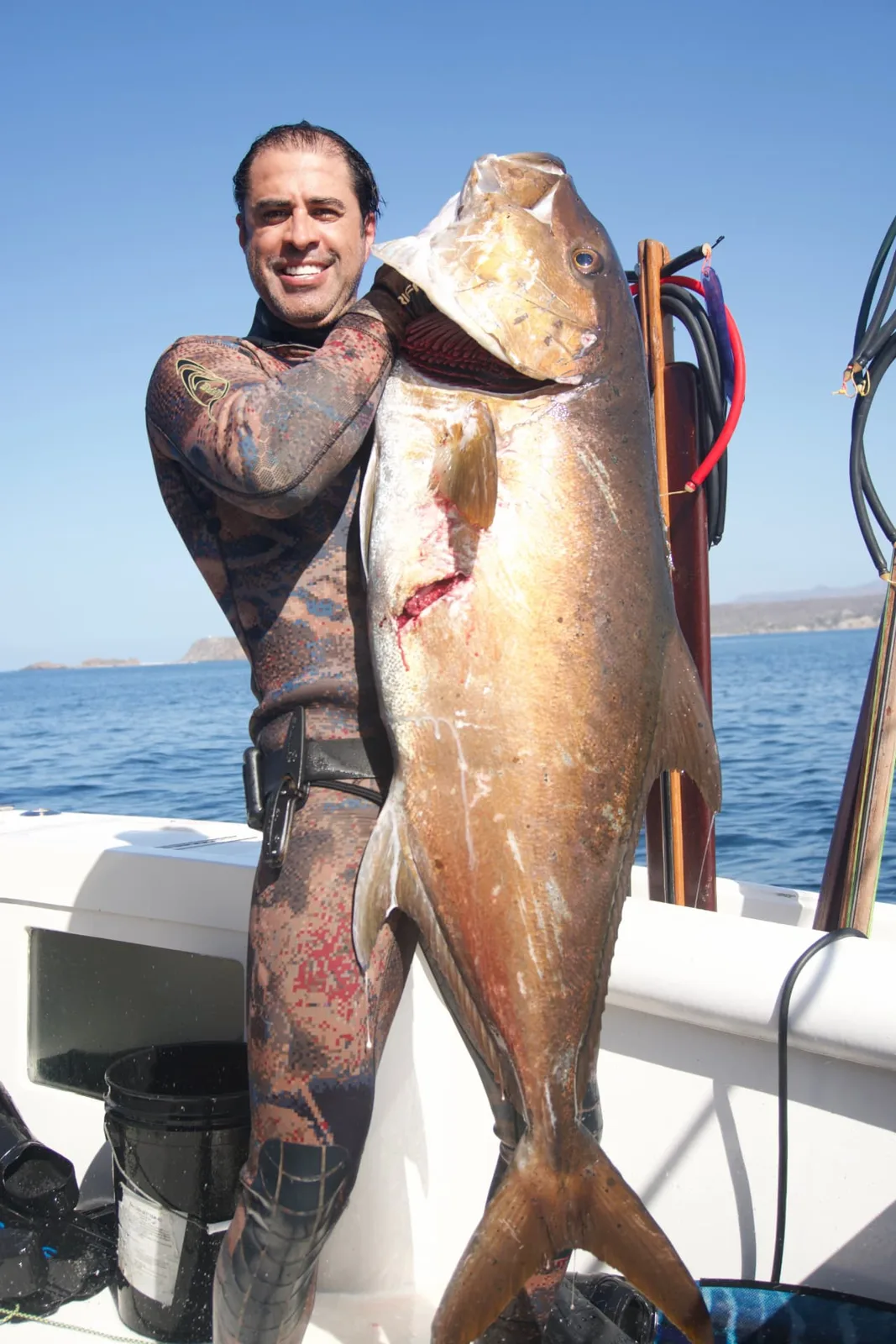
Bluewater spearfishing
Bluewater is a different sport than reef diving. There is no wall, no ledge, no bottom in sight — just open water above and below you and the particular silence of a place with no reference points. Floats and float lines trail behind. You wait, you scan, and you stay calm, because movement in bluewater carries a long way.
Communication matters more than anything: diver to buddy, buddy to guide, guide to boat. Everyone knows where everyone is at all times. The fish, if it comes, comes without warning and from a direction nobody predicted.
It is demanding physically and mentally, and it is not automatically suitable for a first-time diver. Participation depends on ability, conditions, equipment, and the guide's judgement on the day.
For further reading on breath-hold risk, the Divers Alert Network publishes freediving risk assessments at world.dan.org.
Sport fishing offshore
Rod and reel and spearfishing are not competing activities out here. They cover different ground, and running both means fewer wasted hours.
- Trolling while covering water between areas
- Casting toward visible surface activity
- Fishing around bait concentrations
- Working current lines and floating structure
- Adapting tackle to whatever opportunity actually appears
Lines may be in the water while we travel through productive water, depending on the plan for that stretch. Yellowfin tuna, mahi-mahi, wahoo, and other pelagic species are all possible. None of them is promised, and any operator telling you otherwise is selling something other than fishing.
Sunset, dinner, and the first night offshore
The last hour of light offshore does something to people. The water goes from blue to bronze to something almost black, and the whole boat gets quieter. There is usually one final rod-and-reel session in that light, and it is often the one everyone remembers.
Then gear gets secured, and dinner begins. When the day has provided a suitable, legally retained fish and it has been handled properly, a portion goes on the grill. That is the intention, not a promise — Catch & Cook depends entirely on the catch and on safe handling.
Stories from the first day come out over the food, generally growing slightly. Afterwards the boat settles into the rhythm of open water, and there is nothing to do but rest for day two.
If sleeping arrangements or onboard facilities matter to your decision, ask us directly before you book. We would rather tell you plainly than have you find out at sea.
Day Two — bluewater and the tuna grounds
Approx. 6:00 AM
Breakfast with the day already moving
The fishing day gets underway while breakfast happens. Lines may already be in the water.
From there we travel toward offshore drop-offs and tuna grounds.
Morning
Drop-offs, bluewater, or rod and reel
We spearfish the drop-offs, dive bluewater, or fish with rod and reel — whichever the conditions actually support.
A full morning session runs until it makes sense to stop.
Midday
Break, eat, hydrate, recover
Offshore days are long. The midday break is not a luxury; it is what makes the afternoon session worth having.
Afternoon to sunset
Second session and dinner
Back out for the afternoon, working reef structure or open bluewater depending on what the day has shown us.
We finish around sunset, prepare another Catch & Cook dinner when the day provides a suitable catch, and rest for the final morning.
Day two is the heart of it. By the second afternoon there is a real fatigue in the boat — sun, salt, movement, early starts — and alongside it a sharper focus. People have stopped checking their phones. They read the water without being asked. Small things become funny. Someone spots birds before the guide does and will mention it for the rest of the trip.
That is the part nobody puts in a brochure, and it is the reason people come back.
Searching for yellowfin tuna
Yellowfin are respected for good reason. They are fast, extraordinarily powerful, and built for endurance, which makes both the fight and the dive genuinely serious. They also never stop moving, and they stay tied to bait and productive water rather than to any location.
Which is why the phrase “tuna grounds” needs honesty attached to it. It does not describe a place where tuna are always waiting. It describes offshore areas where conditions may create an opportunity, and where experience says it is worth looking.
What actually determines the day is a running assessment: bait concentrations, bird behaviour, surface movement, current, water temperature, what we and other boats have seen recently, the weather, and the safe operating range of the trip. Sometimes it all lines up. Sometimes it does not, and we say so.
No encounter, strike, catch, or shot opportunity is ever guaranteed.
The Catch & Cook tradition offshore
Everything about how we treat a retained fish starts before it is landed. Cool it fast, handle it properly, protect the quality, and only take what will be used.
The cooking offshore is simple by necessity and better for it. Fish on a grill, a hundred kilometres of open water in every direction, plates passed around a boat full of tired people.
Offshore, dinner is more than the end of the day. It is the moment the entire experience comes together.
What ends up on the plate depends on the species, the handling, and food-safety conditions. Raw preparations only happen when the fish and the circumstances genuinely make them appropriate.
Day Three — the final session
The last morning has a different energy. Breakfast, then one more session, using the best conditions available and pushing until it is time to go.
Around 2:00 PM we leave the offshore grounds and turn back toward La Cruz, adjusting the timing if weather, safety, or operating conditions require it.
Then the coastline returns, slowly. After days of nothing but water, the first faint line of the Sierra behind Banderas Bay lands harder than it should. The boat gets quiet again. Nobody is in a rush to arrive.
Bringing the catch home
Appropriate, legally retained catch is carefully filleted, portioned, vacuum-sealed, and prepared for transport. It is treated as food from the moment it comes aboard, with as little waste as possible.
Not every guest goes home with fish. That is fishing. And we cannot make promises about airlines, customs, export rules, refrigeration, or transport — confirm current requirements with your airline and the relevant authorities before you travel.
What the expedition demands
An honest list, because the wrong expectations ruin good trips.
- Long days and early mornings
- Serious sun exposure
- Wind, swell, and movement for hours at a time
- Limited personal space
- Sleeping aboard a working boat
- Weather that can change the plan
- Extended travel between areas
- Real seasickness risk for those prone to it
- Constant hydration
- Patience during long searches
- The physical cost of repeated diving
- Following the guide's instructions without debate
You do not need to be a professional angler. You do need to be genuinely comfortable with all of the above, because this trip does not suit everyone and we would rather say so in advance.
For spearfishing participation, ability, comfort in open water, conditions, and the guide's judgement determine the plan.
What to bring
- Sun-protective shirts and clothing
- A hat that stays on in wind
- Polarised sunglasses
- Appropriate sunscreen
- Swimwear and a towel
- Light wind and rain layer
- A warm dry layer for nights
- Multiple changes of dry clothing
- Personal medication
- Seasickness medication if recommended by a medical professional
- Toiletries
- Waterproof phone case
- A small dry bag
- Charging bank
- Camera or action camera
- Personal mask, fins, or wetsuit if approved
- Any required travel documents
Confirm the final packing list, provided equipment, meals, drinks, sleeping arrangements, and storage limitations with us before departure. Space aboard is finite.
Responsible offshore fishing
This is not negotiable for us, and it is not a marketing line.
- Current permits
- Legal size and catch limits
- Seasonal closures
- Protected-species rules
- Responsible billfish handling and release
- Selective harvest rather than volume
- Careful fish care
- Avoiding waste
- Respecting protected areas
- Leaving no trash or fishing line in the ocean
Official recreational-fishing information for Mexico is published by CONAPESCA at gob.mx. Rules change, so we work to what is current rather than what used to be true.
Who is this expedition for?
A good fit if you
- Want a genuinely remote open-ocean experience
- Accept that fishing is unpredictable
- Are comfortable with extended boat travel
- Can adapt when the plan changes
- Want both sport fishing and spearfishing
- Value the experience beyond the final catch
- Are prepared for basic overnight life aboard
Talk to us first if you
- Have limited swimming experience
- Have never been offshore
- Are highly susceptible to seasickness
- Have mobility or medical concerns
- Need specific sleeping or bathroom facilities
- Are bringing children
- Require specialised equipment
Prefer a shorter day?
- Single-day offshore trips
- Reef fishing and reef spearfishing
- Beachside Catch & Cook
- Guided spearfishing course for beginners
The expedition
This isn't simply a fishing trip.
It's 2.5 days completely immersed in the ocean—offshore pinnacles, deep drop-offs, bluewater hunting, pelagic fish, spearfishing, sport fishing, sunsets, open-ocean camping, and fresh fish cooked over the grill.
Three days. One boat. Endless bluewater.
Hunt it. Catch it. Cook it. Live it.
Every one of those activities remains dependent on safe conditions and on what the ocean actually provides.
Frequently asked questions
Why is it called a 2.5-day expedition if it spans three days?
Because it covers roughly two and a half days of fishing time across three calendar days: a full first day, a full second day, and a final morning session before the return run begins around 2:00 PM.
Where does the expedition depart?
Marina La Cruz de Huanacaxtle, with departure at approximately 5:00 AM.
How far offshore does the boat travel?
The first offshore pinnacles are approximately 30 miles out, and the trip may work areas around 50 to 60 miles offshore when conditions permit. Distances are approximate and depend on weather, safety, current, and fuel planning.
Is yellowfin tuna guaranteed?
No. Yellowfin follow bait, current, and water temperature, so no trip can guarantee an encounter, a strike, or a shot opportunity.
Can guests sport fish and spearfish?
Yes, the expedition is built around combining both. Which one happens at any given moment depends on conditions and the guide's read of the water.
Is bluewater spearfishing suitable for beginners?
Not automatically. It is physically and mentally demanding, and participation depends on ability, comfort in open water, conditions, equipment, and the guide's judgement.
Where do guests sleep?
Guests stay aboard the boat overnight. For details of the specific sleeping arrangements, contact us before booking so we can describe them accurately for the vessel running your trip.
What meals and drinks are included?
Meals aboard include Catch & Cook preparations when the day provides a suitable, legally retained fish. For the full list of included meals and drinks on your specific trip, contact us before booking.
Are there bathrooms or showers onboard?
Onboard facilities vary by vessel. Please ask us directly before booking rather than assuming, especially if facilities are important to your decision.
What fishing equipment is provided?
Contact us for the current equipment list for your trip. Guests may bring a personal mask, fins, or wetsuit when approved in advance.
What should guests bring?
Sun protection, layers for cool nights, multiple changes of dry clothing, personal and seasickness medication, a dry bag, waterproof phone case, charging bank, and any travel documents. Confirm the final packing list with us, as storage space is limited.
What happens if the weather changes?
Safety comes first. The route, timing, and activities are adjusted as needed, and a trip can be shortened, changed, or rescheduled when conditions require it.
How is retained catch prepared for transport?
Appropriate legally retained catch is filleted, portioned, vacuum-sealed, and prepared for transport.
Can guests fly home with their fish?
We cannot make promises about air travel with fish. Airline rules, customs requirements, and refrigeration logistics change, so confirm current requirements with your airline and the relevant authorities before travelling.
Are fishing permits included?
Recreational fishing and underwater fishing in Mexico require appropriate permits, and we operate under current regulations. Contact us to confirm exactly what is included for your trip.
How far in advance should guests book?
As early as you can, particularly for holiday periods, larger groups, and fixed travel dates. Multi-day expeditions have limited availability.
If the offshore expedition sounds like your kind of trip, tell us your dates and who is coming, and we will give you a straight answer about what to expect.