
· 11 min read · Spearos Pacífico
Sunrise over Punta Mita has a particular colour to it. The point goes from grey to gold in a few minutes, the palms behind the marina start to move, and the water outside the headland tells you most of what you need to know about the day ahead.
From that first moment past the point, the boat has two honest directions. It can stay closer to the coast and work the local reefs, ledges, and rocky structure that have fed this stretch of Nayarit for generations. Or it can keep going — past the bay, out toward pinnacles, drop-offs, and open bluewater where the bottom falls away and the fishing becomes a search.
Both trips leave from the same Pacific. Within an hour they stop resembling each other at all. This guide is about choosing between them honestly, because neither one is automatically the better day.
What inshore fishing means in Punta Mita
Nobody here defines inshore by a line on a chart. We use the word to describe a habitat and a style of day: water close enough to the coast that structure does the work for you.
- Local reefs and rocky bottom
- Reef edges and ledges where fish hold
- Points and headlands that concentrate current
- Coastal current seams
- Any patch of water where bait has gathered
The practical advantages are real. Travel is shorter, so more of your morning is spent fishing rather than watching the horizon. Switching techniques is easy. Reef and coastal species are within reach. Sport fishing and spearfishing can often happen on the same trip, and the day ends close enough to shore to make a beachside Catch & Cook the natural conclusion.
What inshore is not is a guarantee of flat water. Wind direction, swell angle, and season all matter close to the coast too. Some mornings the reef is glass; some mornings it is not.
What offshore fishing means
Offshore leaves coastal structure behind and commits to the open Pacific. What replaces the reef is subtler and more mobile.
- Offshore pinnacles rising out of deep water
- Drop-offs and steep contour changes
- Current lines and temperature breaks
- Floating debris holding bait and shade
- Bait concentrations and surface activity
- Working birds
- Open bluewater with nothing beneath it for a long way
Offshore fishing asks more of everyone: more travel, more fuel, more specialised gear, more patience, and a lot more flexibility. A good offshore guide may spend hours moving between areas looking for productive water rather than anchoring a single spot. That searching is not wasted time — it is the fishing.
Inshore species around Punta Mita
Depending on season and conditions, the reef holds a genuinely interesting mix.
- Yellowtail snapper — smaller, sharp-eyed reef fish that reward a careful approach.
- Green bar snapper — a handsome local reef species found around structure.
- Cubera snapper — powerful reef predators that live tight to structure and fight accordingly.
- Triggerfish — distinctive, curious reef fish that can make excellent table fare when appropriately harvested.
- Green jacks — fast, energetic, and capable of producing a fight far beyond their size.
- Other local reef fish that appear as conditions change.
None of these are promised on any given trip. The reef decides what shows up.
Offshore species around Punta Mita
Beyond the bay, the cast changes to migratory fish.
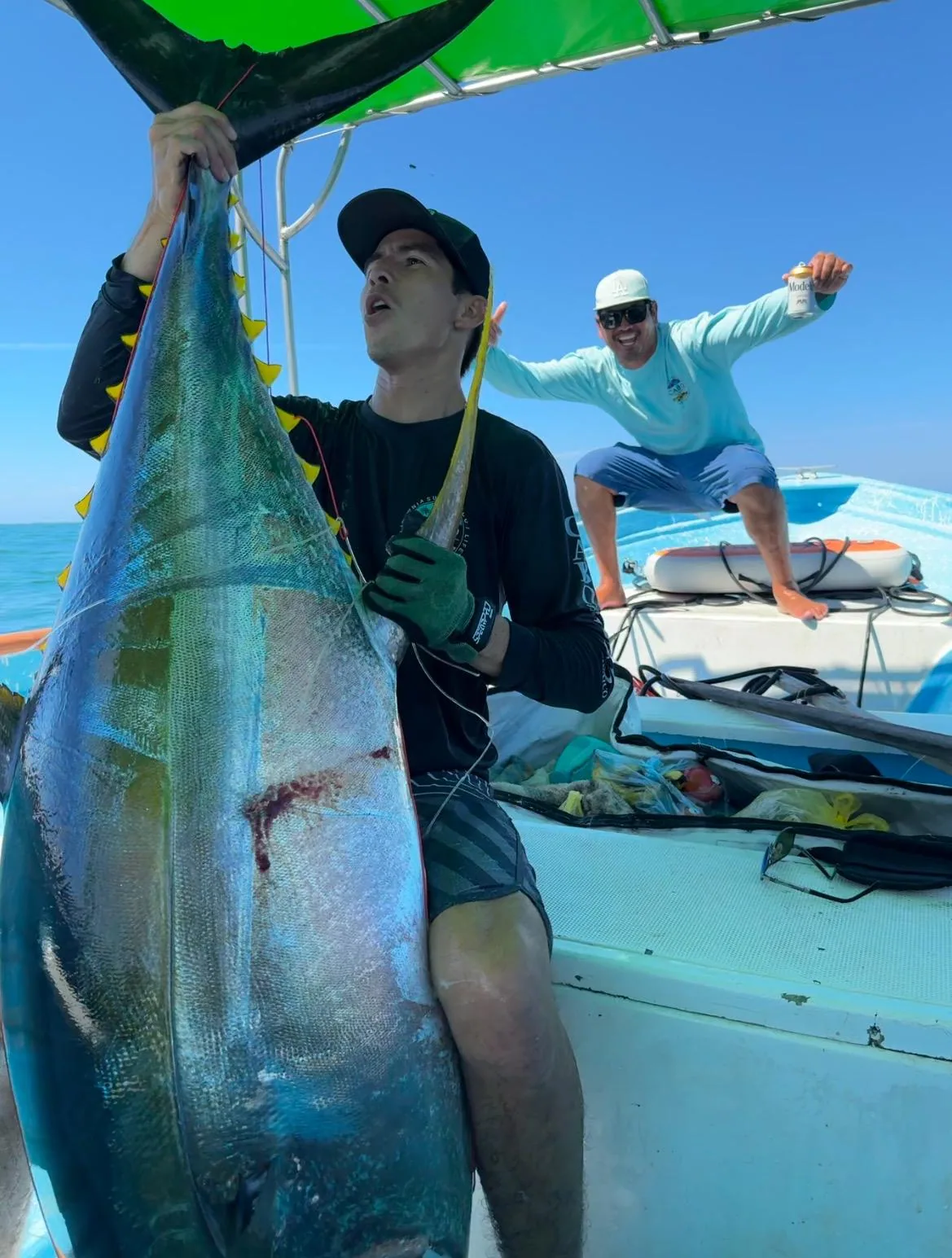
- Yellowfin tuna
- Mahi-mahi (dorado)
- Wahoo
- Sailfish
- Marlin
- Other migratory offshore species
These fish move with water temperature, current, bait, surface activity, weather, and larger ocean patterns. That is why no honest operator publishes a guaranteed species calendar or a success rate. When billfish are involved, we prioritise responsible handling and release — careful boat work, minimal handling time, and letting the fish swim away strong.
How the fishing methods differ
Inshore techniques
Close to the coast, the approach is varied and hands-on: casting to structure, jigging along ledges, fishing live or cut bait, drifting a productive edge, working the bottom, or getting in the water and hunting the reef with a speargun. It is easy to change method mid-morning when the fish tell you to.
Offshore techniques
Offshore, the work is broader. Trolling covers ground. Casting to surface activity turns a sighting into a shot at a fish. Birds and bait get followed. Current lines and floating structure get fished carefully. Experienced divers may enter the water for bluewater spearfishing when conditions and ability allow. The plan changes the moment the ocean shows you something better.
Inshore and offshore spearfishing
Spearfishing splits along the same line, and the difference is bigger than most people expect.
Reef spearfishing
You can see the structure. Ledges and reef edges give you reference, fish identification is easier, harvesting can be genuinely selective, and travel is usually shorter. It is the right place to build skill.
Bluewater spearfishing
Open water, deep nothing beneath you, pelagic fish, floats and heavier bluewater equipment, and conditions that demand real experience, planning, and supervision. Bluewater spearfishing is not automatically appropriate for a first-time guest. Participation always depends on ability, conditions, equipment, and the guide's judgement on the day.
For further reading on breath-hold risk, the Divers Alert Network publishes freediving risk assessments at world.dan.org.
The boat ride and ocean conditions
This is the part guests underestimate most.
Inshore trips generally mean less travel, faster access to fishing ground, and more freedom to move between spots. Depending on wind and swell direction, some coastal areas offer partial protection — though never a promise of calm water.
Offshore trips mean longer travel, earlier departures, and far more exposure to swell, sun, wind, and changing weather. They are physically more demanding, there can be long stretches without action, and the experience feels genuinely remote. For a lot of people that remoteness is the entire appeal.
How much time should you allow?
Inshore fishing suits an active morning and works well when your time is limited. Offshore fishing benefits from a longer trip, because travel and searching are a real part of the day rather than an interruption to it.
For guests who want maximum time in the offshore environment, our 2.5-day expedition is the deepest version we run.
- Departure around 5:00 AM from Marina La Cruz de Huanacaxtle
- Roughly 30 miles out to the first offshore pinnacles
- Continued exploration toward areas approximately 50–60 miles offshore when conditions permit
- Spearfishing and sport fishing across the trip
- Sunset sessions and overnight stays aboard
- Fresh Catch & Cook dinners on the water
- A final morning session before the run home
- Appropriate retained catch filleted, portioned, vacuum-sealed, and prepared for transport
Route and schedule can change according to weather, safety, current, and fish activity. Not every offshore trip follows this itinerary — most offshore days are single-day trips.
Which option is better for beginners?
Inshore is usually the more approachable introduction, mostly because there is less travel and more flexibility if something is not working. But suitability still depends on weather, ocean conditions, your health and mobility, swimming ability if you plan to spearfish, comfort aboard a boat, and the method you have in mind.
Plenty of first-time anglers do very well offshore, provided they are comfortable at sea and prepared for a long day. Offshore or bluewater spearfishing is a different matter and generally requires prior experience.
Describe your experience honestly when you book. It helps us put you on the right trip rather than the one that sounded best in a brochure.
Which option is better for families?
Not every trip suits every family group. The right choice depends on ages, swimming ability, comfort aboard a boat, expected travel time, conditions, trip length, and the fishing method.
Message us with the details of your group and we will recommend something appropriate rather than guessing.
Inshore fishing and Catch & Cook
The reef trip pairs with our Catch & Cook experience for one simple reason: you are already close to shore when the fishing ends.
The morning departs around 8:00 AM. We fish or dive a local reef, harvest thoughtfully, and then run to a calm stretch of white sand near The St. Regis Punta Mita Resort. Seats and tables come out, cold drinks come out, and your guide prepares the catch — sashimi, ceviche, grilled fish, or whatever the species and safe handling suit best. Then there is time to eat, swim, and stay on the beach a while.
Preparations always depend on the species, safe handling, and what the ocean actually gave up that morning.
What to bring
- Sun-protective clothing
- A hat that stays on in wind
- Polarised sunglasses
- Appropriate sunscreen
- Swimwear and a towel
- A light windbreaker
- Personal medication
- Seasickness medication if recommended by a medical professional
- Reusable water bottle
- A small dry bag
- Waterproof phone case
- A change of dry clothing for longer trips
For offshore days, take sun protection and hydration more seriously than you think you need to, rest the night before, and sort out seasickness preparation in advance rather than 20 miles out.
Permits and responsible fishing
Recreational fishing from a boat and underwater fishing in Mexico both require appropriate permits. Current rules on size limits, catch limits, seasonal closures, protected species, permitted methods, and marine protected-area boundaries all apply and can change, so we work to what is current rather than what used to be true. Official information is published by CONAPESCA at gob.mx.
Responsible fishing, in practice, is simple: take only what will be used, release fish when it is appropriate or required, handle every fish carefully, and respect protected areas.
Side-by-side comparison
| Inshore | Offshore | |
|---|---|---|
| Distance and travel | Shorter runs close to the coast | Longer runs into open water |
| Typical environment | Reefs, ledges, points, rocky structure | Pinnacles, drop-offs, current lines, bluewater |
| Potential species | Snapper, triggerfish, jacks, other reef fish | Yellowfin tuna, dorado, wahoo, sailfish, marlin |
| Fishing methods | Casting, jigging, bait, drifting, bottom techniques | Trolling, casting to activity, searching bait and birds |
| Spearfishing style | Reef spearfishing on visible structure | Bluewater spearfishing with floats |
| Trip length | Half day to full day | Full day, or a multi-day expedition |
| Physical demands | Moderate | Higher — long hours and movement |
| Weather exposure | Less travel time exposed, but never guaranteed calm | Significant sun, wind, and swell exposure |
| Best suited for | Active reef-focused mornings and limited time | Open-ocean searching and pelagic goals |
| Catch & Cook | Pairs naturally with a beach meal | Possible on multi-day trips aboard |
| Flexibility needed | Some | A lot |
How to choose
Inshore
- Closer to the coast
- More time actively fishing
- Reef fishing or reef spearfishing
- Pairs with Catch & Cook
Offshore
- Open-ocean travel
- Pelagic fishing and bluewater techniques
- Longer, less predictable days
- Higher physical demands
Multi-day expedition
- 2.5 days offshore
- Pinnacles, drop-offs, tuna grounds
- Sunset sessions and nights aboard
- Catch & Cook dinners on the water
The best trip is not determined by how far the boat travels. It is the one that matches the guest, the conditions, and the kind of experience they came to Punta Mita to find.
Frequently asked questions
Is inshore or offshore fishing better in Punta Mita?
Neither is better. Inshore offers shorter travel and reef-focused fishing; offshore offers open-ocean searching for pelagic species. The right choice depends on your time, goals, comfort at sea, and the conditions that week.
Which trip offers more time actively fishing?
Inshore, in most cases. Shorter runs mean a larger share of the day is spent fishing rather than travelling and searching.
What fish can be caught inshore?
Possibilities include yellowtail snapper, green bar snapper, cubera snapper, triggerfish, and green jacks, along with other local reef species. Availability varies with season and conditions.
What fish can be caught offshore?
Possibilities include yellowfin tuna, dorado, wahoo, sailfish, marlin, and other migratory species. These fish follow temperature, current, and bait, so nothing is guaranteed.
Is offshore fishing suitable for beginners?
It can be, for a first-time angler who is comfortable at sea and ready for a long day. Offshore or bluewater spearfishing generally requires prior experience.
Is inshore water always calmer?
No. Wind direction, swell angle, and season all affect coastal water. Some areas offer partial protection depending on conditions, but calm water is never promised.
Can guests spearfish on both trips?
Reef spearfishing is available on inshore trips. Bluewater spearfishing offshore depends on experience, conditions, equipment, and the guide's judgement on the day.
Can sport fishing and spearfishing be combined?
Often, yes. Many guests do both on the same trip, and the multi-day expedition is built around combining them.
Which trip is best for yellowfin tuna?
An offshore trip, and the 2.5-day expedition gives you the most time around pinnacles, drop-offs, and tuna grounds. Tuna still move with conditions, so no trip guarantees them.
Which trip is best for Catch & Cook?
The inshore reef trip. It ends close to shore, which is what makes the beachside meal near The St. Regis Punta Mita Resort possible.
How should guests prepare for an offshore trip?
Sleep well, hydrate, bring serious sun protection and layers, sort seasickness medication in advance if you are prone to it, and expect long stretches of travel and searching.
Are catches or target species guaranteed?
No. Species, methods, locations, and results vary with season, weather, ocean conditions, and fish activity. Catch is never guaranteed.
What happens when weather conditions change?
Safety comes first. We adjust the plan, change area, shorten the day, or reschedule when conditions require it.
If you are still weighing it up, tell us your dates, your group, and what you hope to experience. We will give you a straight recommendation rather than the longest trip on the list.